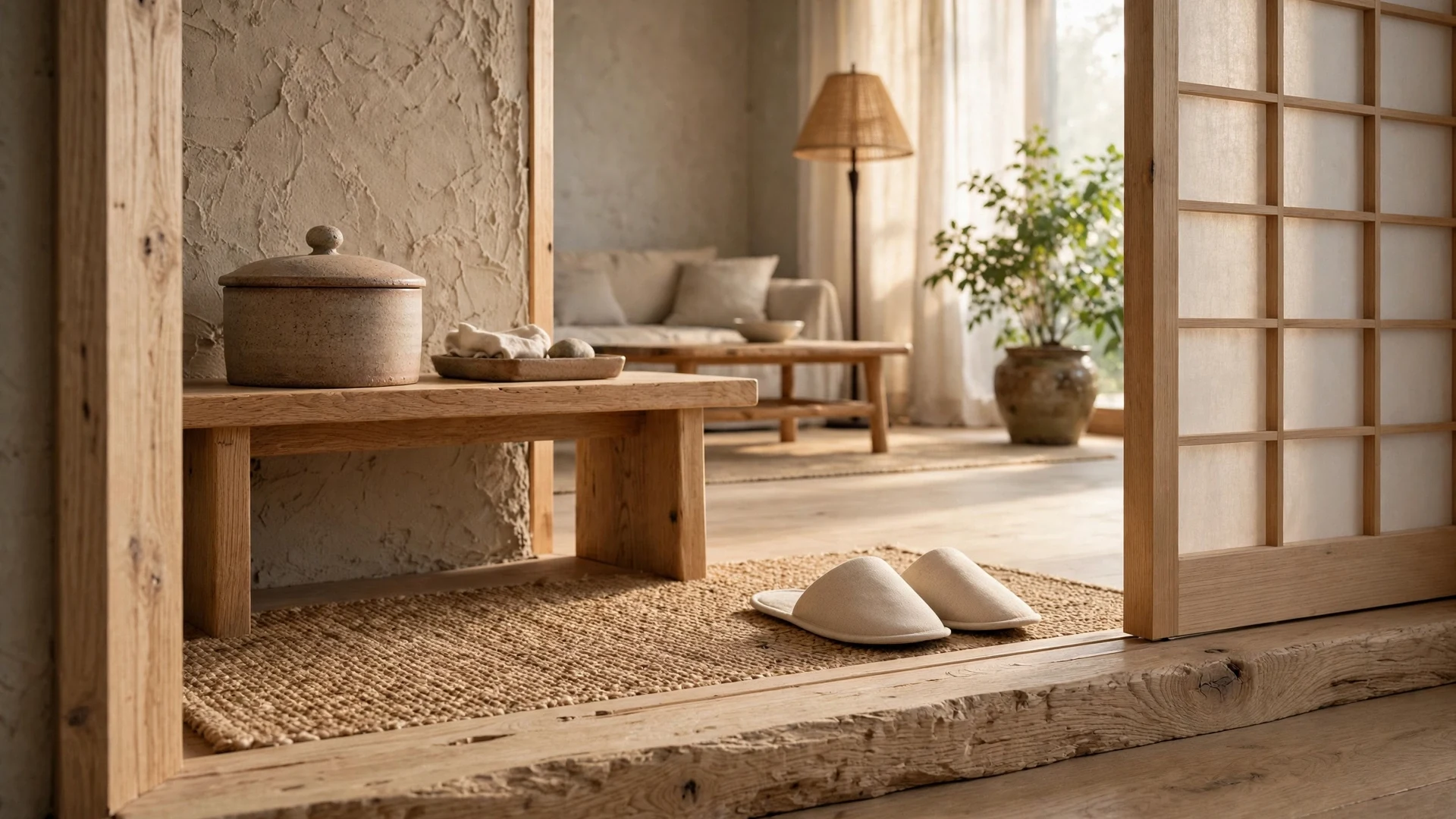
There is a moment, crossing from hallway to living room, when your thought thins out. You arrived in the next room slightly less present than you left the last one, and nothing visible explains why. Our third field log gives that moment a name — the invisible barrier effect — and a surprising measurement: the barrier can be as small as one centimetre of floor that changes without asking permission.
I. Spatial Microclimate & Sensory Acoustics — Doorway Hesitation and Attention
Every doorway is a small decision. The body reads the floor before the mind reads the room: a change of level, a hard metal strip, an abrupt switch from timber to tile. When the change is accidental — a raised lip of laminate, a threshold bar screwed down as an afterthought — the reading costs attention. You hesitate, microscopically, at the exact point where one activity is supposed to end and another begin. Researchers of attention call this an event boundary; the log calls it, more plainly, a toll. One crossing is nothing. A home asks for hundreds of crossings a week, and the tolls compound into the flat, unexplained tiredness of an otherwise tidy apartment.
The microclimate shifts at the same line. Sound changes first: footfall on hard strip, then silence on weave. Light changes second: corridor glare giving way, or failing to give way, to the softer field beyond. Where the transition is sharp and unmarked, the nervous system stays braced on both sides of it — there is no point in the journey where standing down is announced. Where the transition is deliberate, the opposite happens. A strip of unvarnished oak underfoot, a woven mat that swallows the step's small noise, daylight decelerated through a washi screen: each one tells the body the crossing is complete. The room after the doorway finally feels like a different room, and the mind is allowed to arrive in it.
This is the measured core of the 1cm mistake. The error is not the centimetre; many fine thresholds have one. The error is a centimetre that means nothing — no material change to announce it, no pause built around it, no light softened beyond it. An accidental edge fragments attention. The same edge, made intentional, becomes the cheapest reset point in the home.
II. The Architectural Philosophy — Genkan, Engawa and Intentional Thresholds
Japanese domestic architecture never left the crossing to chance. The genkan drops the entry a deliberate step below the living floor, so that arriving home is a physical sentence: street ends here, house begins. The engawa stretches the same courtesy along the garden edge — a veranda strip that is neither inside nor outside, where the body slows before it settles. Even the shoji participates: paper and lattice turn a hard boundary into a gradient, so light, sound and sight all cross gradually, the way dusk crosses a room. Threshold, in this tradition, is not a line. It is a short, designed duration.
The modern rental deletes the duration and keeps the line. One floor plane, one light temperature, doorways that are merely holes in plaster. The field log rebuilds the duration with pieces that ask nothing of the landlord. Begin underfoot: an honest oak transition where levels change, its grain unvarnished so the foot learns it by touch. Lay a woven runner across the crossing so footsteps soften at the exact moment of arrival. Give the pause a place to happen — a low bench, a lidded basket, a tray that receives keys and the day's small cargo in one gesture instead of scattering it across two rooms. Then soften what waits beyond: light through washi or linen, edges rounded by shadow rather than trim. None of this is decoration. It is punctuation. A home with punctuation can be read at walking pace; a home without it must be scanned, endlessly, like a sentence with no full stops.
Four tactile pieces used in this log
Laid where floor levels change, the unvarnished oak edge makes the 1cm step deliberate — felt by the foot before it is seen, so the crossing stops costing attention.
Placed across the doorway's landing side, the weave swallows footfall noise and gives the arrival a softer acoustic — the sound of having reached somewhere.
A pause point with a seat and a lid. Keys, post and bags land here in one gesture, so visual clutter stops leaking across the threshold into the room beyond.
A renter-safe way to borrow the shoji gradient: applied to a glazed door or sidelight beside the entry, it decelerates hard daylight into the soft field the crossing deserves.
Affiliate Disclosure: As an Amazon Associate, Komorebi Threshold earns from qualifying purchases.
Continue the study with us
Each week the lab publishes one field log — a measured room, a corrected mistake, a calmer threshold. Join the discussion on Facebook, and watch the full field investigations on YouTube.
Interior imagery in the video is AI-illustrated and labelled as such on YouTube.