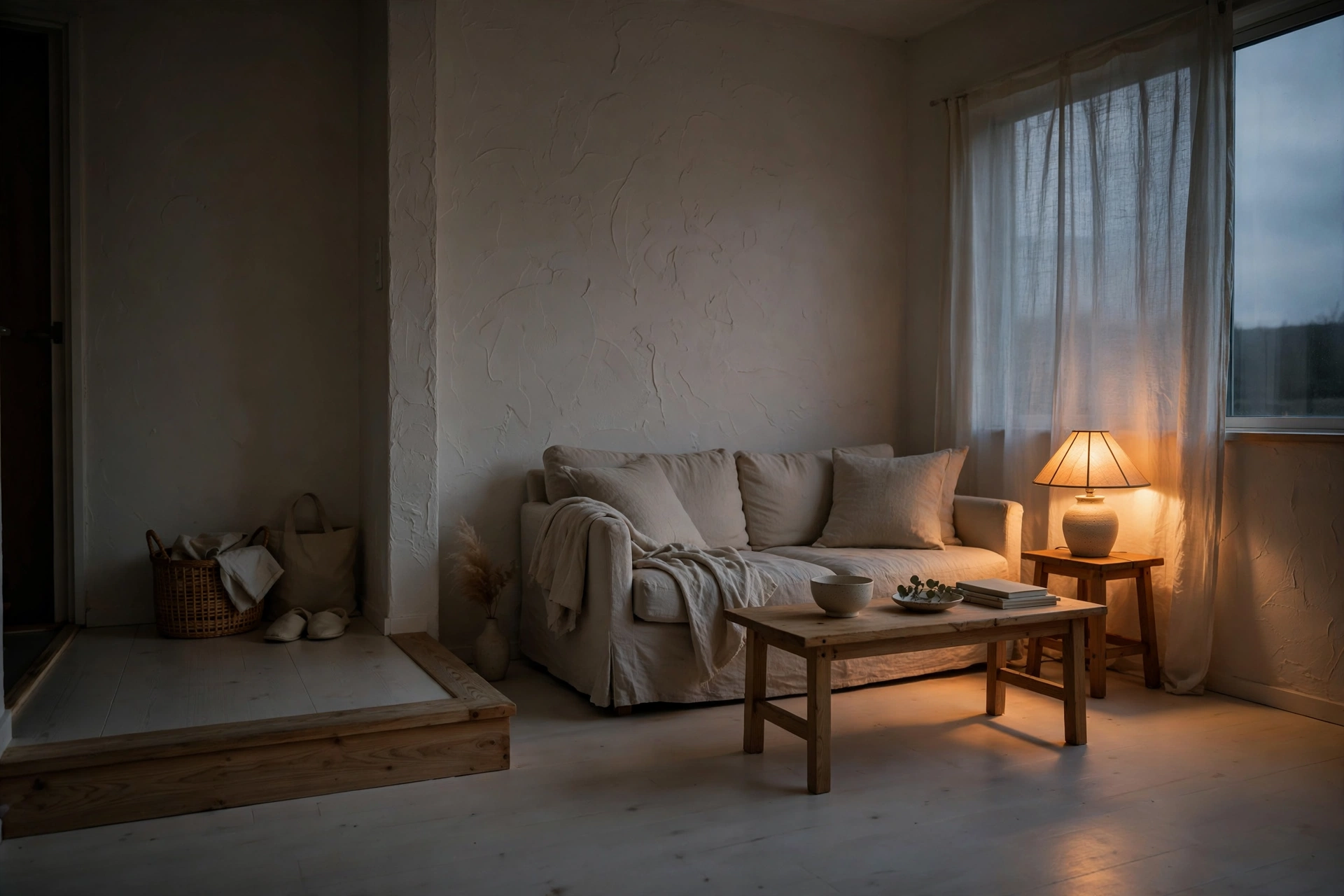
Stand in a beige Japandi apartment at eight in the evening and something quiet goes wrong. The oak is pale, the walls are warm, the sofa is linen — and yet the room reads flat, faintly cold, faintly restless. The instinct is to buy better furniture. Our measurements suggest the instinct is wrong. What collapses after dark is not the palette. It is the light field the palette was photographed in.
I. Spatial Microclimate & Sensory Acoustics — Japandi Lighting in a Small Apartment
In the Komorebi Spatial Engine’s site logs, a north-facing room at midday can register close to 12,000 lux at the window plane. Traditional Japanese interiors were designed to decelerate that energy — through deep eaves (hisashi), translucent shoji, and layered thresholds — down to resting levels near 450 lux, where the eye stops defending itself and begins to rest. The modern rental does the opposite. A single cool ceiling source, often 4000K or higher, strikes beige surfaces at full intensity until the moment you switch it off. There is no gradient. And a room without a gradient has no depth, however expensive its furniture is.
This is the number-one lighting mistake in contemporary Japandi interiors: designing for daylight and lighting for interrogation. Cool, uniform, overhead light flattens the micro-shadows that give oak grain, tatami weave, and hand-troweled plaster their tactile presence. It also pushes the room’s sensory acoustics in the wrong direction. Hard light and hard surfaces compound one another — bare plaster, lacquered floors, and glass return both glare and echo. Texture is not decoration here; it is acoustic and optical dampening. A woven rush mat, an unsealed timber shelf, a crumpled linen throw: each one is a small device for slowing reflections, of sound and of light alike. Research on evening light exposure, including Harvard Medical School’s notes on blue light and circadian rhythm, points the same way — the spectrum you sit in after sunset governs how readily the nervous system stands down.
The correction is unglamorous and almost free: move the light down, warm it up, and give it something to filter through. A 2700K source at seated eye level, shaded by washi-style paper or linen, rebuilds the gradient the room lost. Corners deepen. The oak warms by association. The beige stops reading as an absence and starts reading as a climate.
II. The Architectural Philosophy — Threshold, Shoji and Soft Daylight
The second failure is at the door. In the Japanese vernacular house, you never step directly from street to living space. You pass through the genkan — a sunken threshold where shoes, weather, and the day itself are set down — and along the engawa, the perimeter porch that lets a room breathe without fully opening. These are not stylistic flourishes. They are decompression chambers, regulating dust, humidity, temperature, and psychology in a single stepped gesture. The Western rental deletes them entirely: one door, one plane, living room. The nervous system notices the missing buffer even when the mind cannot name it.
A threshold can be rebuilt without construction, which is the heart of this field log’s weekend protocol. One low oak step or platform at the entry. A woven mat to receive shoes. A half-screen or linen curtain to interrupt the sightline. Nothing drilled, nothing painted — three objects that re-stage an ancient sequence: arrive, pause, descend, enter. Combined with the relit evening layer and one or two genuinely tactile surfaces, the apartment stops feeling like a showroom that happens to contain your life, and starts behaving like a climate built around it. Japandi, in the end, is not a colour scheme you purchase. It is a set of transitions you rehearse daily, in light, in texture, and at the door.
Four tactile pieces used in this log
The core instrument of the fix. Placed at seated eye level beside the sofa, its paper-toned shade rebuilds the evening gradient that overhead light destroys.
Hung at the main window, unlined linen decelerates raw daylight into the soft wash that shoji once provided — and doubles as the entry sightline break.
Laid at the genkan step, the rush weave receives shoes, traps dust, and quiets the room’s footfall — texture working as acoustics.
A matte ceramic body on the oak shelf restores the humidity buffer thresholds once managed passively — and ends the dry, papery feel of heated rental air.
Affiliate Disclosure: As an Amazon Associate, Komorebi Threshold earns from qualifying purchases.
Continue the study with us
Each week the lab publishes one field log — a measured room, a corrected mistake, a calmer threshold. Join the discussion on Facebook, and watch the full field investigations on YouTube.
References noted in the video: Harvard Medical School on evening blue light; PMC3072218; Nippon.com guide to the genkan. Interior imagery in the video is AI-illustrated and labelled as such.