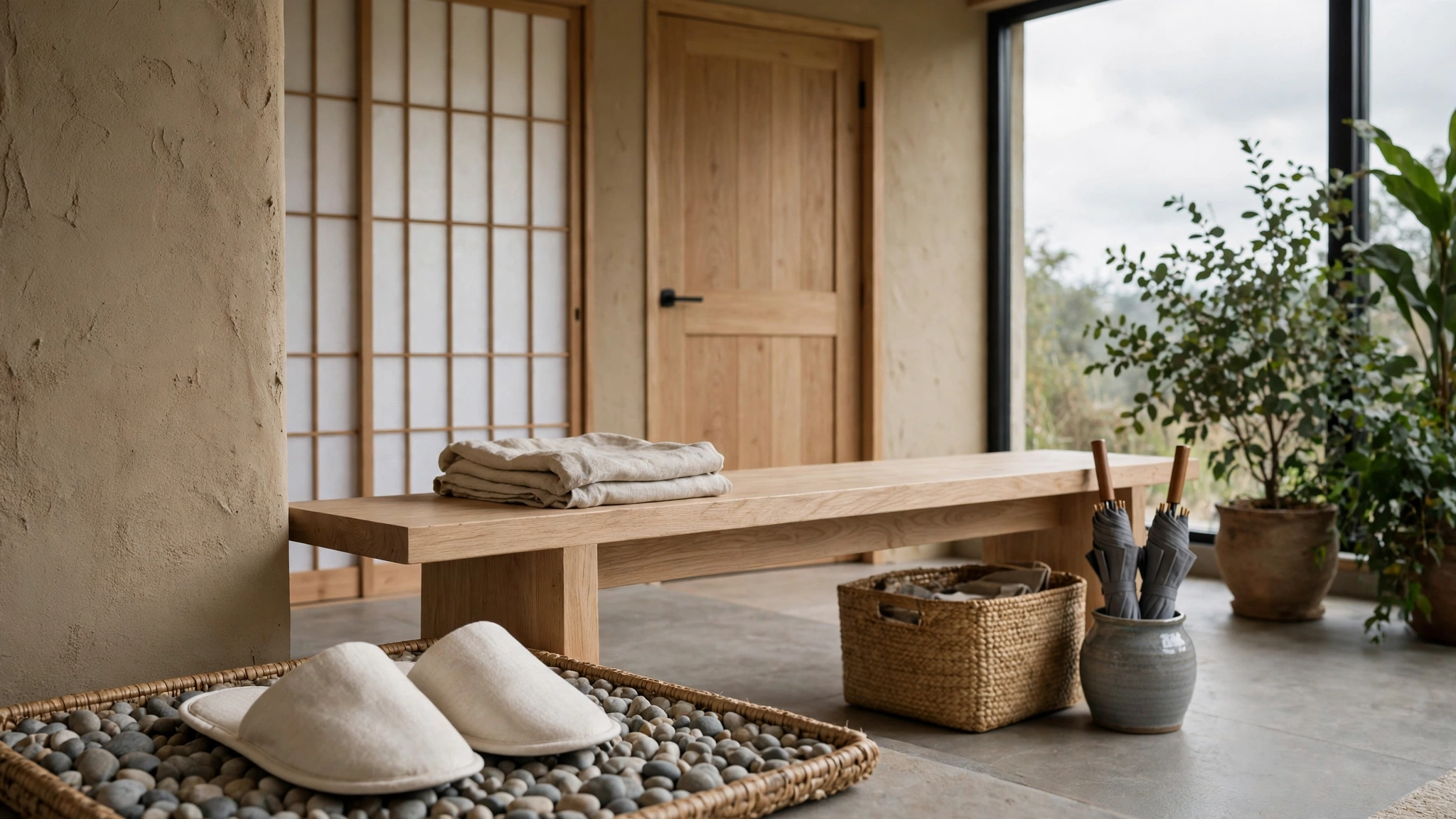
Most small apartments have no entryway at all. The front door opens straight into the room where you eat, work and rest, so the street arrives with you — shoes, keys, weather, hurry. A genkan solves this without a wall. In a traditional Japanese home the genkan is a lowered, hard-floored pocket just inside the door where outdoor shoes stop and the body changes state. Scaled down for a rental, it becomes three deliberate layers: a tray that catches the outside, a bench that forces a pause, and a texture change that tells your feet you are home.
The principle: one pause, three signals
A working genkan sends the same message three ways so the body believes it. First, level: even a 1–2 cm visual step — a mat edge, a tray rim, a change from tile to timber — marks the crossing. Our Field Log on the 1cm step that breaks the flow measured how that tiny hesitation taxes attention when it is accidental, and calms it when it is designed. Second, touch: hard, cool, slightly rough under the shoe, then warm and woven under the sock. Third, light: the entry is kept a little dimmer and softer than the room beyond, often through a shoji-style screen or a linen curtain, so you cross from glare into gradient. When all three signals agree, shoulders drop before you have taken three steps inside.
Keep the palette quiet and the grouping tight. Everything the genkan holds should sit on, under or beside the bench: outdoor shoes on the tray, indoor slippers waiting on the mat, umbrellas in one ceramic holder, a small basket for gloves and leads. If an object needs a second piece of furniture, it does not belong in a small genkan.
Specifications for a small entryway
These dimensions fit a 90–120 cm wide entry pocket in a studio or one-bedroom flat. Adjust depth first; keep heights as listed, because the calm comes from sitting low and reaching little.
| Low bench | 90–110 cm wide × 30–35 cm deep × 32–38 cm high, unsealed white oak; sit to change shoes without balancing. |
| Pebble tray | 60 × 35 cm, rim 2–3 cm; natural pebbles or a coarse woven mat inside to drain and quiet wet shoes. |
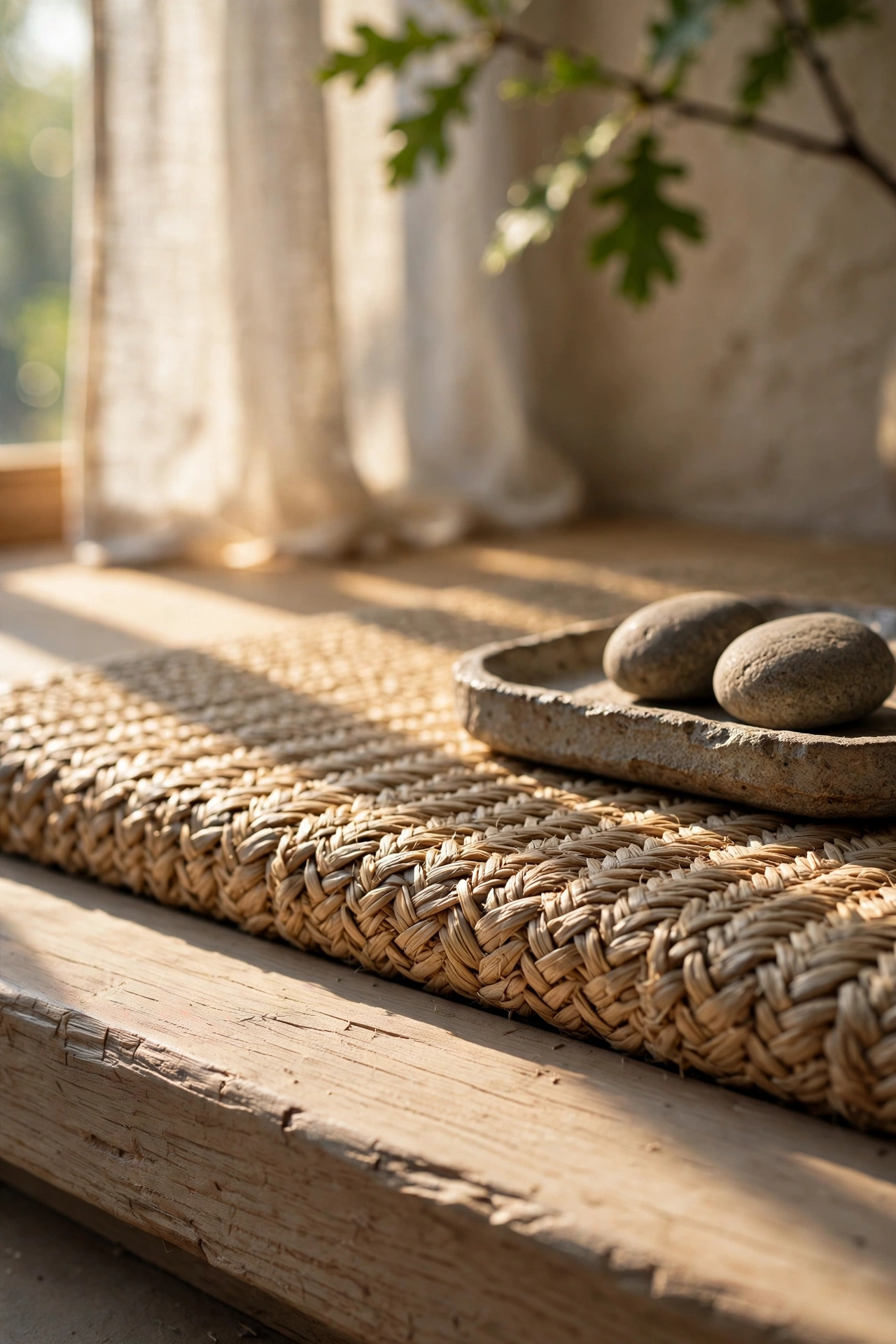
| Woven mat | 70 × 45 cm rush or jute, placed on the room side of the tray; this is the first warm surface underfoot. |
| Umbrella holder | One glazed ceramic cylinder, 45–55 cm high, beside the bench — never a rack that spreads. |
| Light | One warm 2700K source at bench height or shoji-diffused daylight; keep the entry ~30% dimmer than the living room. |
Materials matter more than matching. Choose unsealed or lightly oiled oak so the bench shows use honestly, a mat you can shake outside, and ceramic with enough weight not to tip. Avoid chrome, gloss plastic and anything with a printed logo; the genkan should read as landscape, not storage furniture.
Build it in one afternoon — checklist
- Clear the door swing completely; if a shoe does not fit on the tray, it lives in a closed basket under the bench.
- Lay the tray first, mat second, bench third — in the order your feet will meet them.
- Sit on the bench and change shoes once. If you reach, stretch or wobble, move the tray 5 cm closer.
- Add one plant or one branch only, at the far edge where entry becomes room.
- Test at night: one warm lamp on, main room light off. The genkan should glow, not glare.
- Live with it a week before buying anything else. A good genkan feels finished with three objects.
The reward is disproportionate to the size. A square metre that asks you to sit, set down the day and step onto a warmer surface changes how the rest of the home feels, because every arrival becomes a small ritual instead of a spill. Start with the tray. The pause will follow.
Continue the study with us
Each week the lab publishes one field log — a measured room, a corrected mistake, a calmer threshold. Join the discussion on Facebook, and watch the full field investigations on YouTube.
Interior imagery in the video is AI-illustrated and labelled as such on YouTube.