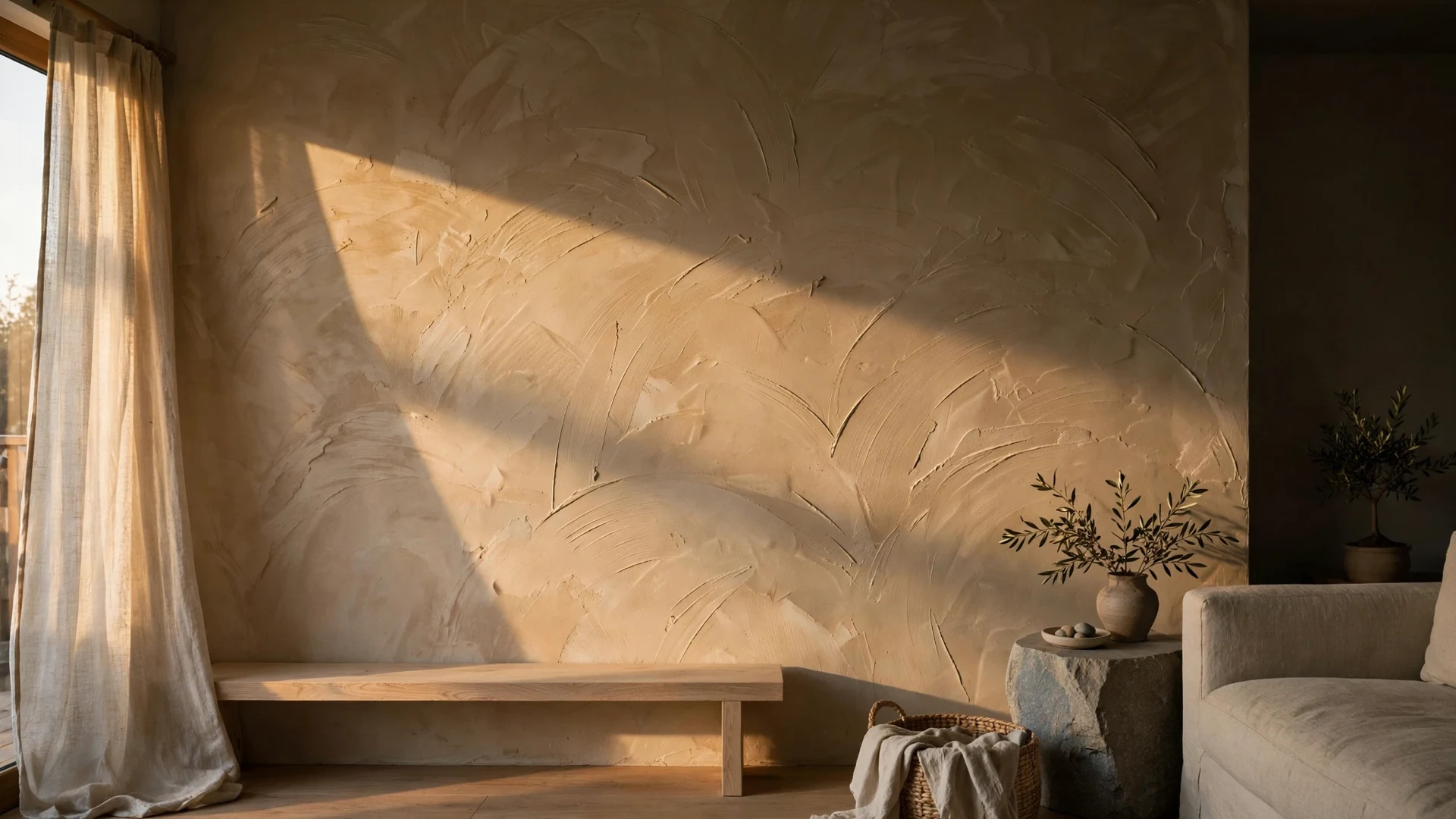
There is a tiredness that has nothing to do with sleep. You can feel it in a bright, tidy, perfectly minimal room: nothing is wrong, and yet your eyes will not settle. They slide across smooth white walls, catch on a hard edge, slide again. The room is calm to photograph and restless to inhabit. Our second field log argues that this restlessness is a surface problem before it is a furniture problem.
I. Spatial Microclimate & Sensory Acoustics — Texture, Sound and Mental Energy
The eye is a scanning instrument. On a flat, uniformly lit wall it finds no resting place, so it keeps taking small, unrewarded trips — across paint, across glare, across the sharp contrast where wall meets ceiling. Each trip is trivial. Hundreds of them across an evening are not. We call this load visual friction: the quiet tax a featureless room charges your attention simply for sitting in it. It is the same tax the first field log found in flat light, collected here through flat surfaces instead.
Micro-texture interrupts the tax. Hand-troweled limewash, unsealed oak grain, honed stone, woven rush: each one breaks a large, empty field into a slow rhythm of tiny shadows. When daylight rakes sideways across limewash, every trowel mark casts a shadow thinner than a fingernail — and the wall stops being a blank to scan and becomes a pattern to rest on. The effect is optical and acoustic at once. Soft, fibrous, uneven surfaces also absorb the small reflections that make a hard room feel brittle: footfall dulls, voices soften, the high, papery echo of a rental box recedes. Texture, in other words, is sensory dampening you can see.
This is why the trick protects mental energy rather than merely decorating a wall. A textured room gives the nervous system fewer decisions to make. Contrast arrives gently instead of in hard steps. The gaze lands, lingers, releases. Nothing demands attention, so attention recovers — the spatial equivalent of lowering your shoulders without being told to.
II. The Architectural Philosophy — Limewash, Oak and Woven Surfaces
Traditional Japanese interiors understood texture as a threshold material. The earthen wall, the tatami edge, the step from smooth timber to woven rush underfoot — each change of surface marked a change of state, without a door having to close. You felt the room change before you thought about it. The modern apartment deletes those signals. One paint, one flooring, one plane from entry to sofa. Zones blur, and the body stays faintly on duty everywhere, because nowhere tells it to stand down.
The field log rebuilds the signal with renter-compatible means. One wall — or even one large panel — in limewash or textured plaster behind the place you sit longest. Warm, honest materials beside it: oak that shows its grain, stone that keeps its matte edge, linen that wrinkles without apology. Then let texture do the zoning a partition usually does. A woven runner laid across timber changes the sound and the pace of a footstep; that change is the boundary. You cross from passage to rest by feel, the way you once crossed an engawa by step. No drilling is required to rehearse the sequence: arrive on hard floor, pause on weave, settle against plaster. Japandi depth was never a colour. It is a rhythm of surfaces the body learns by heart.
Four tactile pieces used in this log
The anchor surface. Brushed in broad, overlapping strokes behind the sofa, it gives daylight a rhythm to play across and the eye a place to rest.
Laid across the timber where living space becomes reading corner, the weave marks the boundary by footfeel — zoning without a wall.
Mounted low along the textured wall, raw oak carries the same micro-shadow language at hand height and warms the plaster by contrast.
Draped over the bench, crumpled linen is the softest form of the same idea: a surface that absorbs light, sound and hurry at once.
Affiliate Disclosure: As an Amazon Associate, Komorebi Threshold earns from qualifying purchases.
Continue the study with us
Each week the lab publishes one field log — a measured room, a corrected mistake, a calmer threshold. Join the discussion on Facebook, and watch the full field investigations on YouTube.
Interior imagery in the video is AI-illustrated and labelled as such on YouTube.