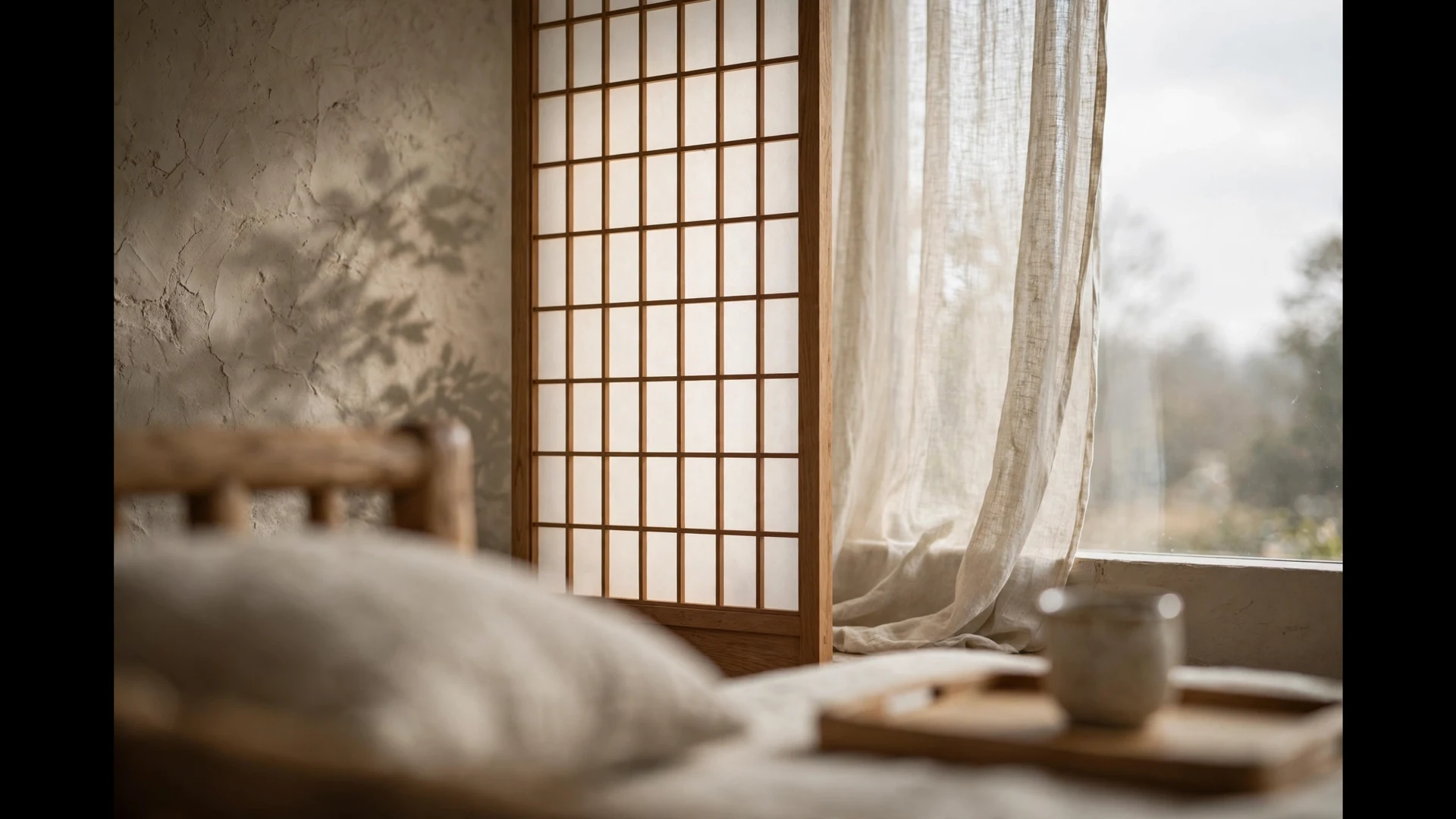
Stand in front of an unshaded window at noon and your shoulders rise a fraction. The light is not just bright; it is directional, edged, and full of contrast the eye must keep re-solving. A shoji screen answers that problem the way a deep breath answers a held one. It does not block the light. It persuades the light to slow down.
Why bare window light keeps a room tense
In Field Log 01 we measured a window peak above 12,000 lx falling to a few hundred lux deep in the room. That steep gradient is the stressor. The pupil works, the eye scans, and every object near the window blows out to white while the far corner sinks. The room feels smaller and louder than it is. This is why south- and west-facing rentals so often feel restless at exactly the hours they should feel golden.
The two-layer rule: linen first, shoji second
Diffusion works in stages. A sheer linen curtain at the glass takes the first cut: it breaks the beam into a general glow and removes the hard shadow lines. A shoji panel standing 20–40 cm inside the room takes the second cut: its washi paper scatters what remains and its wooden lattice gives the eye a calm, regular grid to rest on. Each layer is weak alone; together they convert a beam into a field — light that seems to come from everywhere and nowhere, which the nervous system reads as safety.
Specifications that matter
| Layer order | Sheer linen at the glass → shoji panel 20–40 cm inside the room. Never the reverse: paper first would take the full beam and hotspot. |
| Gap behind shoji | Keep 20–40 cm between curtain and panel. Under 10 cm the lattice shadow prints sharply on the paper and the grid turns busy. |
| Paper tone | Natural warm-white washi. Blue-white paper cools the field and undoes the warmth the diffusion was for. |
| Target field | Aim for an even 300–500 lx at seated eye level in daytime rest zones; the gradient from window to wall should halve, not vanish. |
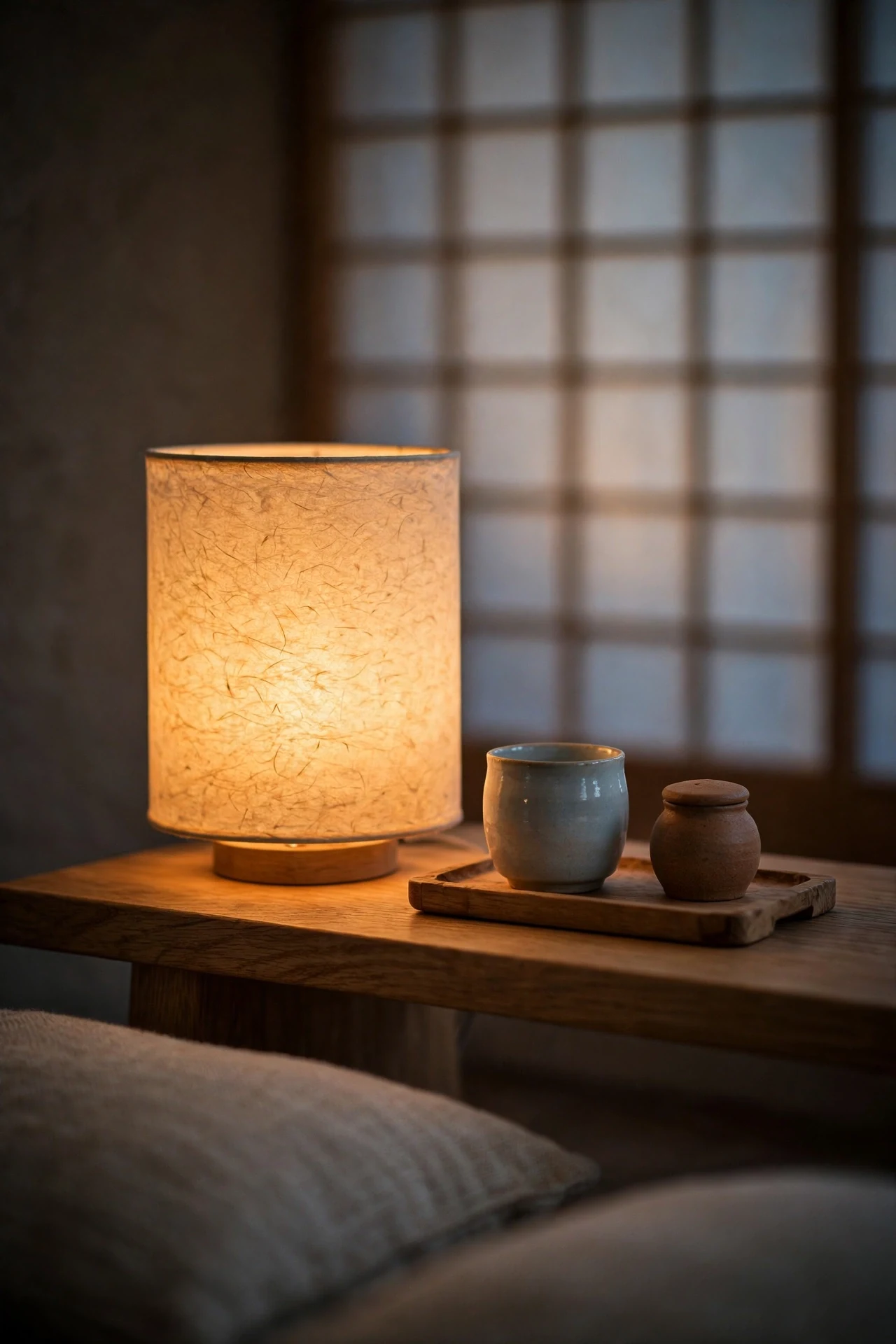
| Evening twin | One washi-shaded lamp at 2700K near the seat, ceiling light off. The shade, not the bulb, is the light source the eye should see. |
A renter checklist (no drilling)
· Hang the sheer linen on a tension rod inside the frame — two minutes, fully reversible.
· Stand a folding shoji screen inside the curtain line rather than fixing a panel; the fold gives you the 20–40 cm gap for free.
· Test at your brightest hour: if you can still see individual lattice shadows printed on the paper, widen the gap before buying anything else.
· Add the washi lamp last, and judge the room at night with the ceiling light off. If the corner still feels exposed, the shade is too small for the seat — size up before adding a second lamp.
None of this dims a room into gloom. The goal is a gradient the body trusts: bright enough to read by, soft enough to rest in, and even enough that the eye stops working. That is what “lowering a room's heart rate” means in practice — fewer contrasts per second for the nervous system to solve. See the full field log: The Light That Flattens a Room →
The diffusion kit used by the lab
Stands inside the curtain line with no fixings. Choose natural warm-white paper and a light oak-toned frame for small rooms.
The first diffusion layer at the glass. Unlined, open-weave linen keeps daylight while erasing the hard beam.
The evening twin of the shoji layer. Fibrous paper softens a warm bulb into a field one seat wide.
How the lab verifies the 300–500 lx target instead of guessing. Five minutes at seated eye level tells you if the layers work.
Affiliate Disclosure: As an Amazon Associate, Komorebi Threshold earns from qualifying purchases.
Continue the study with us
Each week the lab publishes one field log — a measured room, a corrected mistake, a calmer threshold. Join the discussion on Facebook, and watch the full field investigations on YouTube.
Interior imagery in the video is AI-illustrated and labelled as such on YouTube.