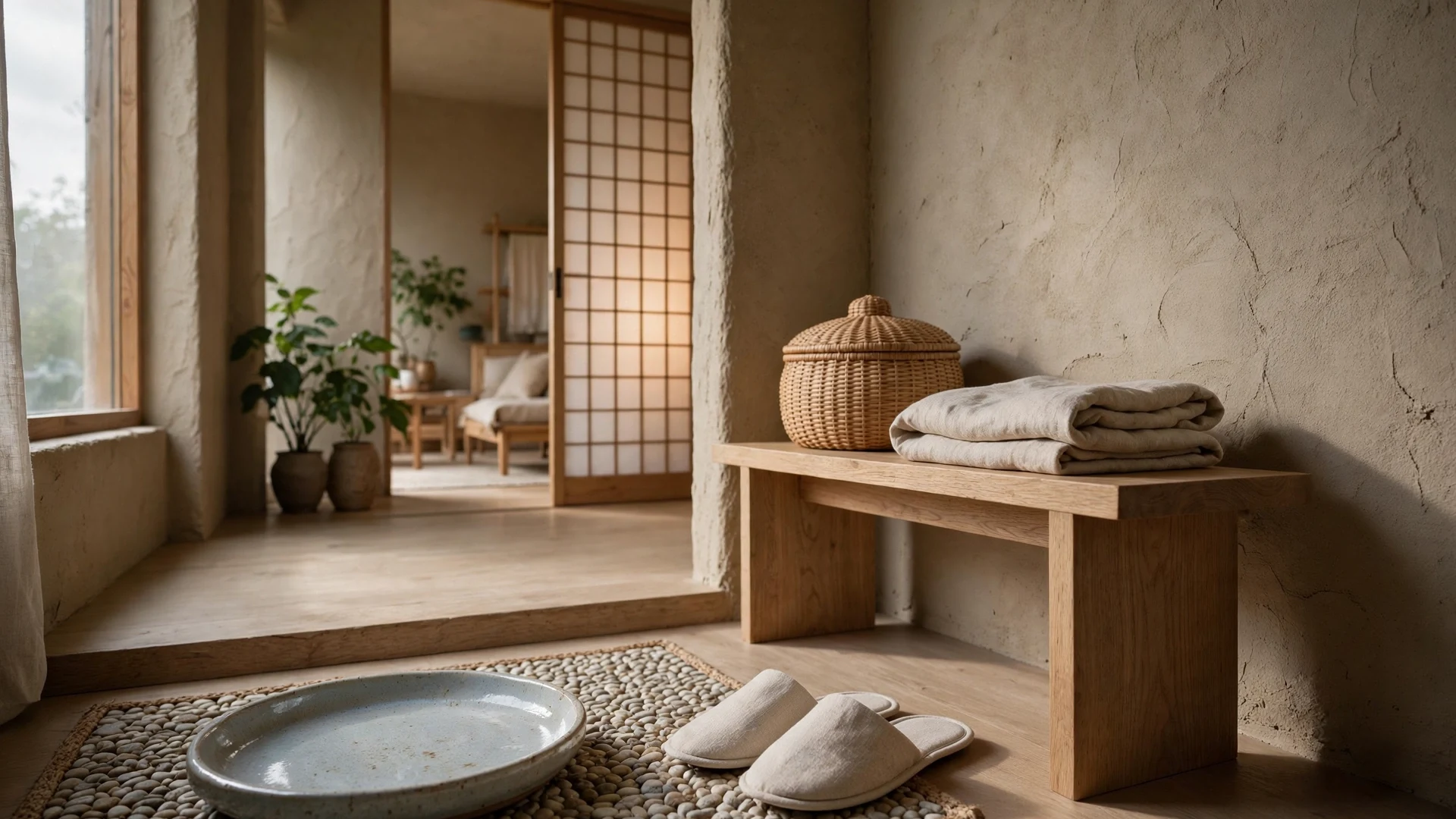
You can read a home's stress level in the first square metre. Shoes drifted from the wall, mail on the floor, keys wherever they landed — each object asks a small question, and the brain answers all of them before you have taken your coat off. This field log treats the front door as what it physiologically is: an attention gate. A Japandi drop zone is the smallest possible answer to that gate — a genkan in spirit, sized for an apartment.
I. Spatial Microclimate & Sensory Acoustics — the entry as an attention gate
The opening chapter, “The Sensory Impact of Cluttered Entries” (00:00), frames the problem correctly: clutter at the door is not a tidiness failure, it is unstructured sensory input at the exact moment of transition. Arrival is when the nervous system switches contexts — from street to home, from work-self to rest-self. Visual noise at that moment leaks into the hour that follows. The fix is not more storage in general; it is a landing sequence in particular: one place to sit, one place for shoes, one closed volume for everything else.
There is an acoustic layer too. A hard, bare entry returns keys, heels and door hardware at full sharpness. The logged drop zone tunes that return with mass and fibre: a woven pebble-textured mat underfoot, a low oak bench that does not ring, linen slippers that replace the sound of outdoor shoes on hard floor. The entry gets quieter in the literal sense, and the rest of the home inherits the calm.
At 01:08 the log names the deeper mechanism — first impressions are sticky. The room you see first becomes the reference mood for the rooms behind it. A composed entry makes the living room feel more composed than it is; a chaotic one contaminates a tidy interior. This is why the drop zone punches above its size: it is the cheapest square metre in the home to fix, and it colours every square metre after it.
II. The Architectural Philosophy — genkan logic in three objects
The traditional genkan separates outside from inside by a level change and a ritual: shoes off, slippers on, a pause between worlds. Apartment entries rarely allow the architecture, so the drop zone borrows the logic instead. A low bench (32–38 cm, as specified in our Genkan Design Guide) gives the body a place to perform the transition. A pebble tray gives shoes a visible boundary — objects inside a border read as “placed”, objects outside it read as “mess”, and the border does the disciplining. A lidded basket closes the volume on everything that has no daily slot: umbrellas, leashes, the bag of bags. The lid is the point. Open storage displays; closed storage rests.
The chapter at 02:17 turns the sequence into a “60-second mental reset”: arrive, sit, shoes into the tray, keys into the ceramic bowl, coat onto the hook, one breath before standing. Sixty seconds is short enough to survive a tired evening and long enough for the context switch to complete. At 04:28 the log widens the idea — a spatial pause, like the tea-room alcove, does not need to be a room. It needs a change of texture, light or level that tells the body the register has changed. At the front door, the woven mat and the step from hard floor to soft slipper do that work in two paces. The final chapter (06:45) reconnects the threshold to nature: the plant by the door is not decoration, it is the last piece of the outside world allowed in on your terms.
For the doorway-mechanics companion to this log, see Field Log 03 on the 1cm threshold step — together they describe the two halves of arrival: the level under your feet, and the zone that receives what you carry.
The three-object drop zone, plus its smallest detail
The seat the reset happens on. Low enough to stay visually quiet, solid enough to take daily weight without a wobble.
The visible border that turns scattered shoes into a placed pair. Stone texture also drains wet soles away from the mat.
Closed volume for the entry's overflow. The lid is what separates a drop zone from a display of everything you own.
One home for keys and cards on the bench's corner. Small, heavy, and exactly where the hand expects it.
Affiliate Disclosure: As an Amazon Associate, Komorebi Threshold earns from qualifying purchases.
Continue the study with us
Each week the lab publishes one field log — a measured room, a corrected mistake, a calmer threshold. Join the discussion on Facebook, and watch the full field investigations on YouTube.
Interior imagery in the video is AI-illustrated and labelled as such on YouTube.