Quiet & Light
Desk Clear on Monday, Buried by Thursday? The One-Tray Rule
A desk fills up because nothing marks the edge of the day's work. Use one tray for today, one box for later and one bin for never.

Your desk is clear on Monday morning and buried by Thursday afternoon, and you never saw it happen. So you add a monitor riser, a pen pot and a drawer unit. The desk gets more places to hold things and fills faster.
The desk is not failing. It has no edge to the day's work, so every task leaves something behind and nothing ever leaves.
Watch the video version

Prefer to watch? The full walkthrough is on our YouTube channel. Subscribe for a new room guide every week.
The test
Without looking, name the three things you used on your desk today. Then count what is actually on it. Keep those three.
What a tea room does differently
In a Japanese tea room the host brings only what the next step needs: a bowl, a whisk, a scoop. Everything else waits in another room. Each object comes in, does its job and goes back, so the room stays the same at every moment.
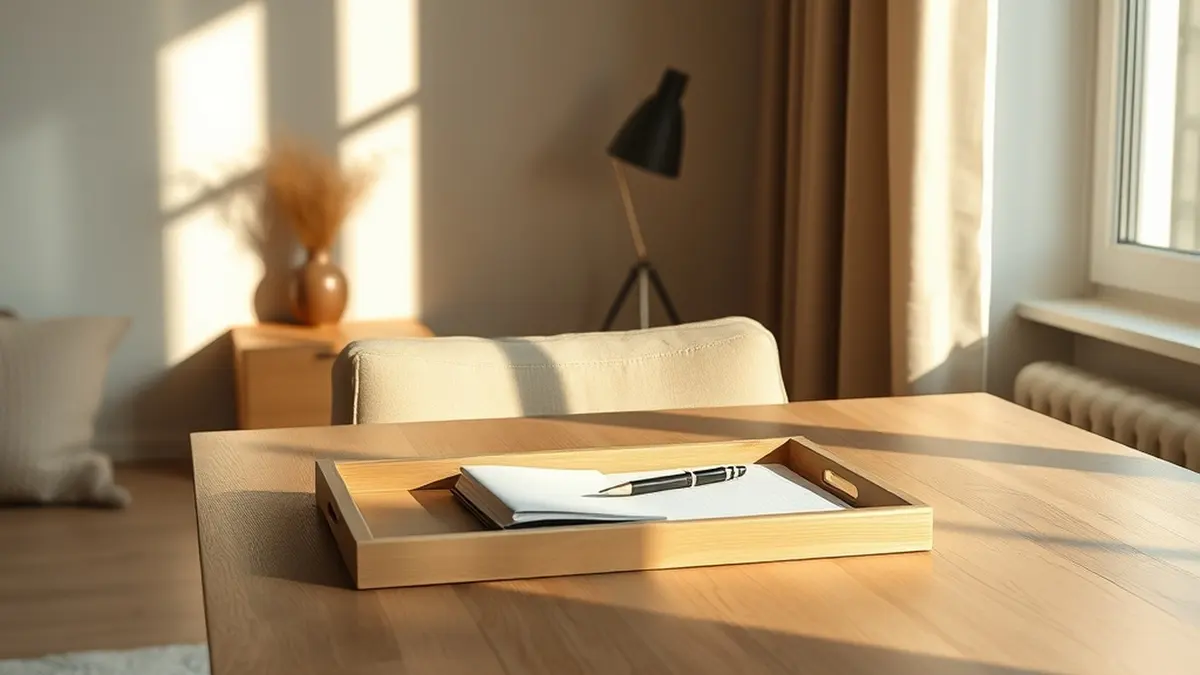
A tray gives your desk the same edge. It is a hard boundary the size of a placemat. Anything that is not on it is not part of today.
One tray, one box, one bin
- One tray for today. Pick one the size of a placemat with a low rim and set it where your writing hand rests.
- One box for later. Any lidded box on a shelf, for things you need weekly but not daily. Label the lid with one word.
- One bin for never. Old receipts, dead pens and half-read leaflets. If you hesitate, ask what happens if it is gone.
The four-step reset (about thirty minutes)
- Clear everything onto the floor, wipe the surface and put back the lamp and the screen.
- Sort the pile into today, this week and someday. Be honest: the notebook you plan to read usually belongs in someday.
- Fill the tray with today, box this week, and put someday in a folder out of sight.
- Set the nightly reset. Ten minutes before you stop, empty the tray, box the week items and wipe the surface.
Clip loose cables to the desk leg with tape so a tangle does not pull the lamp over. Put the lamp on the side of your writing hand so your own shadow does not fall on the page.
When it goes wrong
- The tray overflows by Wednesday. The working set is too big. Finish one task before adding another.
- Paper you cannot throw out yet. Put it in a folder labelled with a month and decide when that month comes.
- A shared table. Use a tray you can carry and a lidded box. At six the table is a table again.
- Post and bags. Give them a landing spot by the door, such as a shallow dish, so they never reach the desk.

Related: for the same idea in a kitchen, read why your kitchen counter is always full.
What to look for
As an Amazon Associate I earn from qualifying purchases. These links open Amazon search results; we may earn a commission at no extra cost to you. You do not need to buy anything to use this guide.
- Desk trayThe edge for today's working set.Search on Amazon
- Lidded storage boxThe weekly box.Search on Amazon
- Cable clipsKeeps cables off the floor and lamp upright.Search on Amazon
- Desk lampPlace it on the side of your writing hand.Search on Amazon
- Shallow catch dishA landing spot for keys and post.Search on Amazon
Save these ideas
Images in this guide are AI-generated illustrations of the ideas described, not photographs of real homes.