Kitchen & Bath
Why Your Kitchen Counter Is Always Full (and the Three-Zone Fix)
Kitchen counters fill up because nothing has a fixed place. Tape out three zones, test every object, and keep one bare stretch for prep.
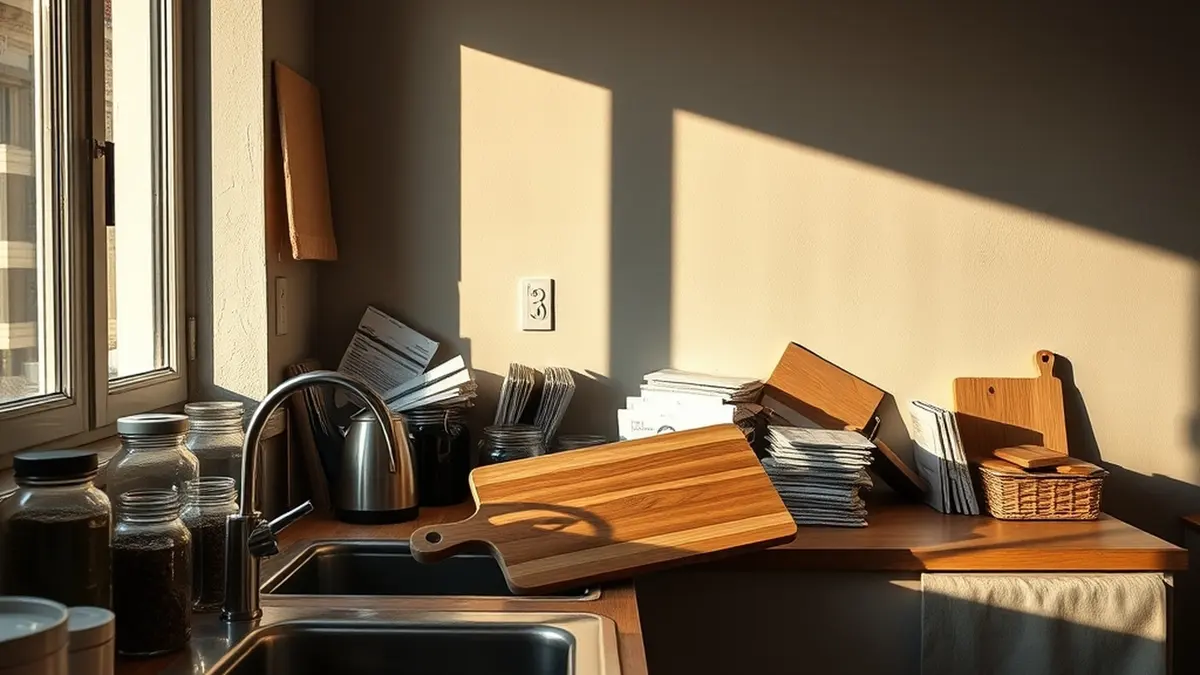
You clear the counter on Sunday. By Wednesday the cutting board is balanced on the sink again. So you buy a tray, a rack and a lidded bin, and two weeks later those are on the counter too. You have not solved the clutter. You have organised it.
The counter is not too small. The problem is that nothing in the kitchen has a fixed place, so everything lands on the nearest flat surface. Look at yours now: kettle, mail, a spice jar, a charger. None of it was put there on purpose.
Watch the video version

Prefer to watch? The full walkthrough is on our YouTube channel. Subscribe for a new room guide every week.
Why small Japanese kitchens stay clear
Many small kitchens in Japan are laid out as one short line: wash at one end, cook at the other, and a bare stretch of counter in the middle for chopping. That bare stretch is not storage and not display. It is the one place where food gets prepared.
Everything else lives close to where it is used. Tools hang on a rail near the stove, bowls sit in the cupboard under the prep area, the rice cooker stays by the sink. The rule is simple: give every object a spot at the exact place your hands use it.
Most kitchens do the opposite. Things are stored where there is room, not where the work happens, so every task starts with a search. Searching is slow, slow gets skipped, and the pan stays on the counter because the right cupboard is one more step away.
The three zones
Think of the counter as a short line of work, in the order you cook.
- Wash zone (around the sink). Only things that touch water: sponge, brush, dish soap, drying rack.
- Prep zone (the middle). A stretch about as wide as your biggest chopping board, with nothing parked on it. This is the zone that stays empty.
- Cook zone (next to the stove). Oil, salt, a spatula and one pan. The things your hand grabs without thinking.
Whatever does not belong to wash, prep or cook goes somewhere else. That is where counters are really decided.
The one-arm test
Stand where you chop and look at everything within one arm's length. Anything you did not use today is on the wrong side of the line. A useful split:
- Daily: stays in reach (the kettle earns a place by the stove)
- Weekly: goes in a cupboard
- Monthly or less: leaves the kitchen altogether (the blender you used in March)
Five steps, about forty minutes
Bring masking tape and a timer, and clear the whole counter onto the table.
- Tape the prep zone. Mark a rectangle as wide as your biggest board. Nothing crosses the tape.
- Sort into three piles: daily, weekly, rarely. Be honest. The kettle is always daily; the juicer never is.
- Put the daily pile back, one object at a time, in its own zone. Hang what you can on a wall rail near the stove. Check the rated weight on hooks and keep them away from hot or greasy walls, since adhesive hooks can let go on tiles.
- Cap the appliances. One tray holds the kettle and the toaster. A new gadget arrives only when an old one leaves.
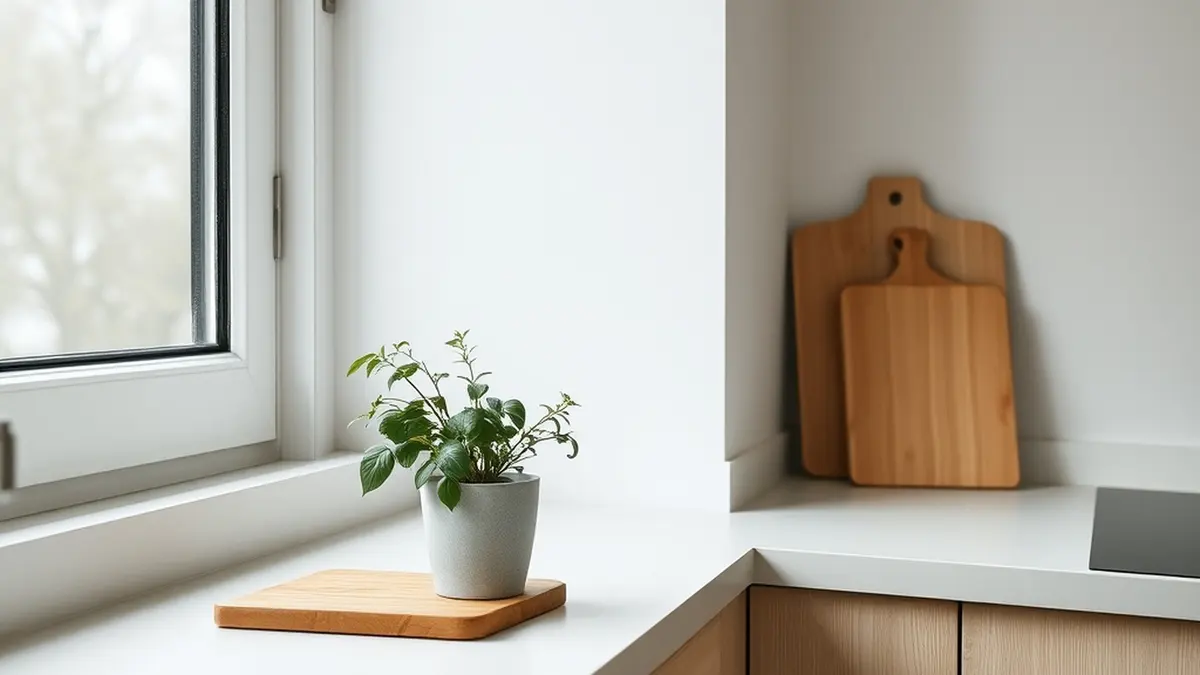
- Clear the dead corner. Every counter has one where things pile up. A plain wooden board or a small plant there stops it filling.
I would not trust a decorative tray stacked with bottles. It looks tidy for a day, then every bottle has to move whenever you wipe down.
If you rent, or the kitchen is tiny
- Can't drill? Use a tension rod under a cupboard or a rack beside the stove.
- Tiny kitchen? Let the prep zone double as the place you eat, and clear it after every meal.
- Big household? Give the wash zone a second rack, but still protect the prep stretch.
- Things you love but rarely use? Box them on a high shelf with a dated strip of tape and look again in three months.
When it fills up again
If the counter is cluttered within a week, the zones are wrong, not you. Look at which objects crept back and move them closer to where you use them. Also check the light: a prep zone in your own shadow is a poor one, and a small light under the cupboard can matter more than another organiser.
The habit that undoes everything is dropping things where your hands stop: a bag, the post, the shopping. Give those a landing spot away from the prep zone, such as a hook and a tray by the door. Our guide to a front door drop zone that actually works shows how.
What to look for
As an Amazon Associate I earn from qualifying purchases. These links open Amazon search results; we may earn a commission at no extra cost to you. You do not need to buy anything to use this guide.
- Wall rail with hooksMoves ladles and tongs off the counter and next to the stove.Search on Amazon
- Under-cabinet LED lightLights the prep zone so you are not working in your own shadow.Search on Amazon
- Tension rod for cupboardA no-drill shelf for renters.Search on Amazon
- Two-tier appliance trayOne tray as the limit for appliances.Search on Amazon
Save these ideas
Images in this guide are AI-generated illustrations of the ideas described, not photographs of real homes.